Blazing The Trail To A Degree

cop-affordable

Earlier this month at the national PromiseNet conference in Kalamazoo, Mich., there was a lot of discussion of fundraising for Promise scholarship programs.

How do you set an appropriate fundraising goal? What is the best way to attract unrestricted gifts for program management? Are matching grants a thing of the past? Is there a way to build a sustainable and reliable source of funding through creative taxation? What is the best ‘pitch’ to lock down a major funder?

Of course, all of those are important questions, particularly for a program just getting off the ground, but there might be even more important initiatives to undertake to get a campaign off the ground or extend the shelf life of a movement as it builds capacity.

I’m going to call it the “Cornerstones of College Affordability.” If you don’t have a dime for scholarships, you can still create dollars for scholars through maximizing pre-existing sources. And if you have scholarship dollars, there are ways to leverage them to make sure that students get up to three times as much money from sources other than the Promise dollars.

Here are the five cornerstones:

1. Federal aid — There is a lot of unclaimed money for low-income students through the Pell Grant program. Students who qualify for Pell can get close to $6,000 annually to cover expenses and many scholarship programs use that as part of the equation in determining a scholarship award. Every program should encourage and assist students and families to complete their FAFSA applications in both accurate and timely fashions.

2. Financial literacy — Those who are first-generation students can find unhappy surprises — not just the hidden costs of college, but also the deadlines for payment. Choosing the right college from the start can make all the difference in getting that diploma. Having access to those who can explain the process and its expectations, even before the selection a school, can help families steer clear of the roughest waters.

3. Institutional aid — Those programs who are forking over checks to colleges have some leverage to create universal benefits for its Promise scholars, particularly if they can demonstrate patterns of increased success in comparison to the broader student body. But you don’t have to wait to begin that conversation. Without question, the earlier students complete applications to college, the stronger the chance they can tap into existing university scholarship pools.

4. Other scholarships — Most places in the U.S. have existing scholarships intended for local students and there are also regional and national award programs as well. The problem is that most students are unaware what is out there. If someone associated with a program can provide resources, the affordability puzzle becomes more complete. There are students who are making college debt-free by taking advantage of multiple opportunities.

5. Paid internships — Not only are students much more likely to find full-time work after college after taking advantage of paid internships while in college, they can also make use of summer work to defray the costs associated with college. Any program that works with the local business community to create such opportunities will produce better results and retain more students after graduation.

No, none of this helps a Promise program with its overhead, but each one helps improve outcomes for students. A promise can mean a lot of things, including the promise to help young people blaze that trail both to and through college.

Hook ‘Em Horns

ut-austin

Add the University of Texas to the ever-growing list of colleges and universities who are branding scholarship initiatives intended to attract high-performing, low-income students.

This program — called Texas Advance — will provide nearly 1,000 scholarships to in-state students worth $20,000 over four years to allow further opportunities for students and provide a more diverse campus.

Straight from the UT News Bureau:

“Making our campus as accessible as possible to students of all backgrounds is extremely important, and Texas Advance is designed to ensure we are helping the students who need it most,” said David Laude, senior vice provost of enrollment and curriculum services.

In total, students can earn up to $15,000 per year when Texas Advance is combined with available Pell and TEXAS Grants, which is enough to cover the cost of tuition, books and fees at UT Austin. Additionally, Texas Advance students are admitted to their first-choice colleges within the university.

Many universities across the country are doing more to address the needs of low-income and first-generation students. A few examples include The Carolina Covenant at the University of North Carolina, the High Achieving Involved Leaders at the University of Michigan, the William & Mary Promise and the Rutgers Future Scholars.

At Cities of Promise, we applaud any and every effort to remove the fiscal peril for high-performing students from low-income backgrounds.

Denver Decides If College Matters Tuesday

cop-denver-hoops

UPDATE: Denver voters rejected the college affordability ballot measure by about eight points. Meanwhile it looks like Pueblo, Colo., will become the next City of Promise as voters passed a measure to apply an excise tax on marijuana cultivators to establish a college scholarship program.

Tuesday is election day and there isn’t that much excitement about it. Ohio’s measure to legalize marijuana is getting a good bit of attention as are tightly contested gubernatorial races in Kentucky and Louisiana. But the number of statewide measures up for consideration are at a 25-year low.

Of course, there are a number of mayoral races to be decided, including places like Charlotte, N.C.; Columbus, Ohio; Des Moines, Iowa; Houston, Texas; Indianapolis, Ind.; Orlando, Fla.; and Philadelphia, Pa.

But for Cities of Promise, we will be focused on Issue 2A in Denver, Colo., which could use a very small slice of city sales tax — eight cents per $100 purchase — to generate $10 million a year for college scholarships.

This measure has wide support and publicity as evidenced by Denver Mayor Michael Hancock and Colorado Governor John Hickenlooper hooping it up for Issue 2A, known as College Matters. But the Denver Post editorial board doesn’t think this should be a city responsibility basically because it never has been.

If passed by voters, the City of Denver will establish a non-profit entity to partner with philanthropy-supported scholarship organizations, which includes the Denver Scholarship Foundation. The measure will “sunset” in 10 years unless voters vote to extend it later.

The message is pretty simple — debt means students can’t contribute to the economy. Voters will choose whether or not to give a penny for every $12 they spend.

And a collective thumb’s up won’t just mean a world of difference for the city’s youth, it would also provide a model to consider for cities across the land.

And we know that the U.S. can use more Cities of Promise.

Community College: New & Free

heads-up-graphic

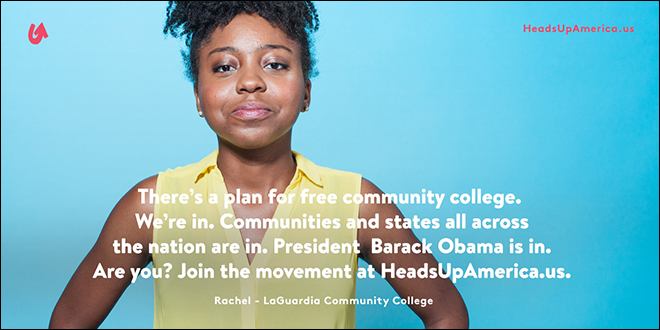
Heads Up America — the awareness campaign for President Obama’s College Promise initiative — is being celebrated on community college campuses this week.

Here at Cities of Promise, we have pulled together a list of two-year college programs which are already in place to provide tuition assistance for its local student body.

Two-year colleges have been around since 1901, when Joliet Junior College in Illinois became a public college offering two years of programming. And now, envisioning college of tomorrow, U.S. News reports that 20 percent of the student bodies at some colleges already have bachelor’s degrees and are adding important job skills for the future.

The roster is deep. Among community college attendees have been astronaut Eileen Collins, businessmen Walt Disney, Steve Jobs, George Lucas and Ross Perot, poet Gwendolyn Brooks, Emmy Award winner Jim Lehrer, baseball Hall of Famers Jackie Robinson and Nolan Ryan, funnymen Robin Williams, Eddie Murphy and Billy Crystal, singers Salt-N-Pepa, Faith Hill and Queen Latifah and an array of actors which include Clint Eastwood, Morgan Freeman, Tom Hanks and Gabrielle Union.

In explaining the history of community college, Time Magazine’s Sean Trainor recently wrote:

Clamoring for both physical and economic access to college learning at a moment when advanced education was becoming key to social mobility (sound familiar?), Americans of a populist persuasion were responsible for the egalitarian streak of the junior colleges that opened beginning in 1901.

Inexpensive, often publically funded, and open to a wider cross-section of Americans than many of their four-year counterparts, these junior colleges were celebrated as “people’s colleges.” Though a far cry from full inclusivity, these male-dominated, majority-white schools nevertheless catered to a broader swath of working-class Americans than nearly any other contemporary educational institution.

Cities of Promise stands in support of our nation’s community colleges and the Heads Up America movement.