U.S. News Focuses On New Haven, Promise Movement

cop-us-news

U.S. News & World Report is featuring the growth of the Promise movement — and we are happy to report the first national shout-out to Cities of Promise.

cop-us-news-logoThe introduction to the piece told the tale of a young woman from a Colorado charter school who found out that the difference between her financial aid package and the price tag at her college would be more than $10,000 — a figure her parents simply couldn’t cover.

But her high school — Peak to Peak Charter School in Lafayette, about a half-hour north of Denver — announced a pilot program intended to ensure that college remain an option for their graduates, regardless of individual financial situations.

While it is unusual for a high school to do this, more and more colleges are following the lead of the nation’s Cities of Promise, where student success has met with opportunity. New Haven Promise Executive Director Patricia Melton — a co-founder of Cities of Promise — was a source for the story.

She said that the Promise movement has led the way for innovative and entrepreneurial thinking. In this case, the grass-roots initiatives have “influenced bolder thinking at the policy level, which tends to take more time,” said Melton. New Haven Promise is currently funding nearly 500 students with more than 100 each at the state’s flagship institution, the University of Connecticut, and New Haven’s Southern Connecticut State University.

Author Allie Bidwell wrote:

Over the last decade, however, more outside foundations have been partnering with cities and school districts to get into the scholarship game, says Carrie Warick, director of partnerships and policy for the National College Access Network.

“I do see an expansion happening at the local level,” Warick says. “I think you will see it through these collective impact initiatives or other collaborations of local, business and nonprofit entities, where the school district will be very involved.”

One of the reasons school districts should be involved, perhaps even in supplying financial support, is that Promise programs help generate significant dollars for them. In New Haven, for example, public school enrollment decreased five straight years before Yale University (ranked third nationally by U.S. News), the Community Foundation for Greater New Haven and Yale New Haven Hospital (ranked among the nation’s top 20 in six categories by U.S. News) established the Promise in 2010.

Since then city-wide public enrollment has jumped each year and is up 10 percent in total, which brings tens of millions of dollars annually to the district and infuses economic development — short term and long term — to the region.
Is Promise Coming To A New Southern City?

cop-say-yes-gboro

By late summer there will be at least one new Promise program to be added to the Cities of Promise, but exactly where it will be is yet to be determined.

According to the Greensboro News-Record in North Carolina, the “leading contender” is its own Guilford County. That newspaper reported last week that Say Yes to Education — which has city-wide programs in Syracuse and Buffalo — is poised to become the organization’s first program outside the Northeast.

Wrote Marquita Brown of the News-Record:

Say Yes has considered applications from more than two dozen school systems and municipalities, Gene Chasin, the chief operating officer of Say Yes to Education, said through a spokesman.

The organization still is considering several of those school systems, Chasin said.

While evaluating communities, Say Yes is weighing such factors as the strength of local leadership, “the openness of local partners to working together, and the commitment of the local school district to its students graduating high school — and doing so college-ready,” Chasin said.

While Say Yes would provide about $15 million in support, local partners — in this case Guilford County Schools, the Guilford Education Alliance, the Community Foundation of Greater Greensboro and the High Point Community Foundation — would be responsible to raise funds to establish an endowment for college tuition scholarships.

“The Class of 2016 could be the first class to receive these opportunities,” said Maurice “Mo” Green, the superintendent of Guilford County Schools. To learn more about the positive measures coming out of Guilford Schools, please click here.


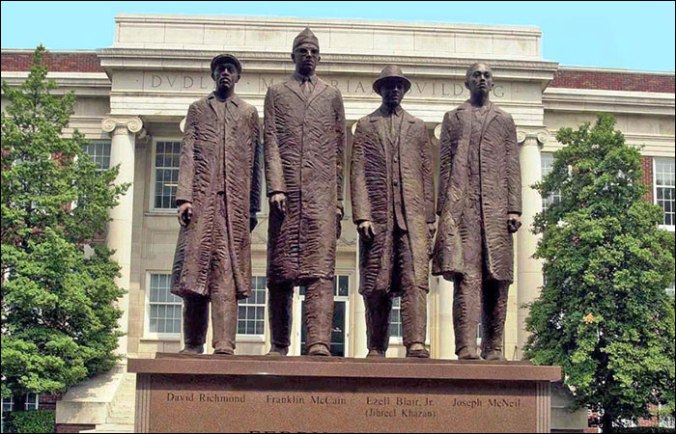
The photo above is a monument to the Greensboro Four, who generated attention to segregated conditions in the South with a 1960 lunch counter sit-in. The statue — which sits on the campus of North Carolina A&T State University in Greensboro — was dedicated in 2002.

Here’s A School Not Ready To Cheer For The Tennessee Promise

cop-ut-martin

While the Tennessee Promise has received much acclaim, the four-year universities back in the Volunteer State have begun to react to the potential ramifications of the focus on community colleges.

One of the universities in the state system — the University of Tennessee at Martin in the rural northwest part of the state — has rolled out the UT Martin Advantage Scholarship and left no ambiguity in the written rationale. Straight from the Scholarship website:

This scholarship was developed in response to the reduction of the Tennessee Lottery Hope Scholarship. As a result of the Tennessee Promise, the Hope Scholarship dropped from $4,000 a year to $3,500 a year for freshmen and sophomores, and we want to give back to those who choose to seek a quality 4-year degree at UT Martin!

The website has multiple references to “the total collegiate experience” and “affordability.” It boasts of “scholarship opportunities comparable to the Tennessee Promise.” Clearly, this 7,000-student branch of the UT system isn’t going to wait to see how the state-wide initiative is going to impact it.

A Promise On Steroids?

cop-smusd-holt

Back in November, at PromiseNet in New Haven, San Marcos Unified Schools Superintendent Kevin Holt served as a panelist for a session called “The Promise Is Not The Beginning,” focusing on the required pre-conditions to start a Promise program. That’s Holt on the far right in the photo above at Yale SOM following the Cities of Promise Town Hall.

Dr. Holt had been a driving force in the establishment of PACE Promise — a partnership between the school district, California State University-San Marcos and the Leichtag Foundation, which provided the funding. In the last five years, PACE Promise has provided financial and academic support to more than 300 students.

But now he is aiming for something larger; something that Logan Jenkins of San Diego’s Union-Tribune calls “PACE on steroids.” On Friday, Dr. Holt will host a city-wide town hall forum, to include political and business leaders, to discuss the creation of the San Marcos Promise, a $100-million investment in the students of the city.

On the table are everything from a parcel tax to a sales tax hike or even sugar daddies like the anonymous donors who have been floating The Kalamazoo Promise in Michigan for nine years now. Dr. Holt wants a multi-investment approach to his goal in making San Marcos the educational hub of the San Diego metro. “I don’t want to depend solely on foundations and corporations,” he told Jenkins.

Jenkins, who is moderating Friday’s forum, calls the proposal a “moon shot.” But we must remember, the moon was conquered.