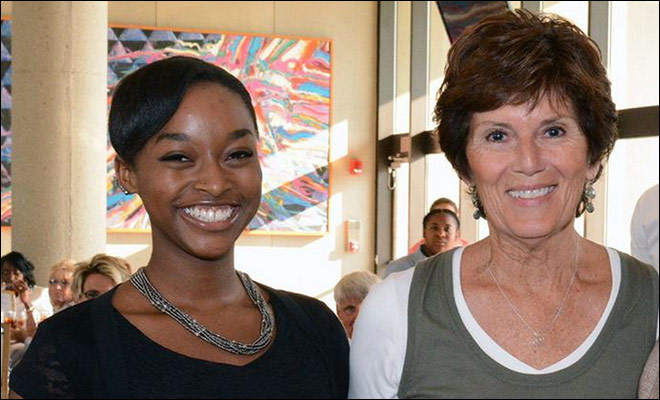
A Personal Promise

ud-mia

By Brett Hoover

Reading this story of Promise, which posted in the Dayton Daily News Monday, was a bit personal.

Not only is this Promise Scholar — Mia DeBrill (above with her mentor Pam Smiga) — now enrolled at the University of Dayton, making her my fellow Flyer, but it reminded me of my youth.

That’s because my father served the University of Dayton for a quarter century, most of it overseeing admissions, financial aid and scholarships. His approach was unlike anything that had been seen. He’d come to the University as a successful football coach, but had to look for greater stability once he had an unexpected third child (me).

A series of hard-fought recruiting victories made administrators take notice and wonder if he might be the person to attack a sagging enrollment. In his switch from athletics to admissions he kept his football approach. Competing wasn’t enough. “To Jim,” said the school’s chief financial officer, “the idea was to go out and win.”

The disruption turned UD’s fortunes. In an era where many private schools suffered declining enrollment, Dayton experienced double-digit increases.

And with all the things he oversaw, perhaps the thing that drew his deepest interest were the scholarship opportunities for students from the City of Dayton. Like many cities, Dayton was built with segregation in mind. The westside of Dayton — separated from downtown by the Great Miami River — was designed to isolate the area’s low-income black residents.

The University of Dayton — one of three Marianist colleges in the United States — sits on the other side of town, a neighborhood of working-class whites on one side and old-money blue blood families on the other.

While I failed to realize, when I was younger, that the school was not a welcoming place for many minorities, I am happy to report that my alma mater has worked to address that into the 21st century. An innovative partner program — the Dayton Early College Academy — has been established across the street.

It also brings me joy to know that UD partners with the Montgomery County Ohio College Promise, which is funding Mia DeBrill’s education. Being there for her — and others to come — might just be more meaningful than providing funds.

External resources and initiatives have changed outcomes since the 1970s and 1980s, when my father was among the few who knew the challenges of black students and the shortcomings of the university. My father recognized that lack of diversity on campus — in a city with more than 40 percent black residents — was both a sore spot for both the city and the university and a drawback for all the students.

He didn’t want to lose any black students. He took all the knowledge and resources he had to make things work for them. Sometimes it wasn’t enough, but I would also hear from my fellow classmates about the difference he made. My dad never stopped being a football coach at heart. There was nothing fluffy about him. Yet I’d hear stories from folks who had stories about his warmth. I eventually had to stop questioning them about it.

James Hoover passed away 12 years ago. Not long after that I quit my job to follow the passion he instilled in me. Most days, at some point, I talk with a first-generation-to-college student or a parent, helping them navigate the difficult process of getting to and through college. I suspect finding joy in that must be in my DNA.

And I want to wish Mia, my fellow Flyer, all the luck in the world!


Brett Hoover — who formerly served as the Associate Director of the Ivy League — is a co-founder of Cities of Promise.

Kindness Always Counts

delta-15

For thousands unexpectedly separated from their loved ones at the worst of times, a region of strangers stopped everything to provide care and support. And the passengers on Delta Flight 15 on Sept. 11, 2001, never forgot.

Perhaps you’ve heard that 53 international flights — about half being U.S. commercial planes — were re-directed to Gander, Newfoundland, in response to the attacks on New York and Washington, D.C., on 9/11. Suddenly a relatively sleepy aviation hub used as a refueling stop for trans-Atlantic flights was filled with “plane people,” thousands of stranded travelers.

The length of stay was uncertain as all public air travel came to a halt and local officials scrambled to assess and address the need. The passengers on Flight 15 would end up in Lewisporte, about 20 miles from Gander. The town’s mayor, Bill Hooper, put out the call to his community for bedding and food. Much more came in return. “They cared for us in so many different ways, but they did it in such a marvelous way. They didn’t hover over you … they just seemed to be very perceptive about what the different people needed,” said Shirley Brooks-Jones, a retired administrator at The Ohio State University, “Essentially, they closed down the town. Everyone was helping. And the shopkeepers in the few places that were open wouldn’t let anyone pay.”

The “plane people” stayed in Lewisporte for three days before getting clearance to fly back home. Tight bonds were made both among the passengers and their caretakers. Brooks-Jones would call it “the most beautiful experience I have ever had in my life.”

As Flight 15 finally prepared to leave Gander, Brooks-Jones asked the captain for permission to address her fellow passengers. There was discussion of the hospitality they’d received and soon pledge sheets — asking for donations to provide college scholarships for the young folks of Lewisporte — were circulating around the plane. By the time they landed in Atlanta, $15,000 had been committed.

When Brooks-Jones returned to Columbus, Ohio, an anonymous donor matched the contribution. The Lewisporte Area Flight 15 Scholarship Fund — formally established and managed by the Columbus Foundation — has now sent well more than 100 Lewisporte Collegiate School students to college and trade schools. More than $2 million has been donated.

Brooks-Jones, pictured above with Raie Lene Kirby of the first cohort of Lewisporte Scholars, has been back to Newfoundland more than two dozen times — each spring to award scholarships and each Sept. 11 to honor the events that tragically brought her to the province in the first place.

Kirby? She’s now a practicing physician.

A Promise Restrained

prison-promise

By Brett Hoover

In early November the nation’s Promise programs will convene in Kalamazoo, Mich., for PromiseNet 2015 and among the events will be a 10th anniversary celebration gala of the ground-breaking Kalamazoo Promise.

But early November will also be the 50th anniversary of the Higher Education Act of 1965, which ushered in a national promise in the form of the forerunner to what would become known as the Pell Grant. That program — named for the late Claiborne Pell, a U.S. Senator from Rhode Island — has been a major factor in the ability of students from lower-income households to attend and graduate from college.

Yet for the last 20 years the most at-risk haven’t been eligible to tap into the funds. The Violent Crimes Control and Law Enforcement Act passed by Congress in 1994 wiped out Pell Grants for the incarcerated. The early 1990s saw new spikes in violent crime in the U.S. and the comprehensive act, signed into law by Bill Clinton, was a “get-tough-on-crime” reaction.

Vivian Nixon and Glenn Martin recently co-authored a plea for the Promise of Pell in our prison system. Published on the website of the Department of Education, Nixon and Martin wrote, “This research clearly demonstrates that access to higher education is actually a boon for public safety; it drives down recidivism rates, improves the lives of incarcerated students and returning citizens, and improves the lives of their families and communities.”

In an age when the U.S. has more jails and prisons than degree-granting colleges and universities, this deserves the attention of Education Secretary Arne Duncan and U.S. Attorney General Loretta Lynch. All across the South, more people live behind bars than on campuses.

The Pell Grant — established to provide an opportunity — has made the country a better place. A promise provides greater outcomes than a penalty.


Brett Hoover — who formerly served as the Associate Director of the Ivy League — is a co-founder of Cities of Promise.

This Town Builds Its Promise

baldwin-promise

Up near the top knuckle of the pinkie finger on the Michigan mitten is a fishing town called Baldwin, which is home to fewer than 1,200 people.

Baldwin’s economic success is seasonal, as tourists come to town in the summer to try to catch trout, salmon and bass. Full-time employment is limited and — before 2009 — a small fraction of the town’s students were earning college degrees.

But a local resident named Rich Simonson — who left Baldwin in the late 1960s to become a key player in Michigan politics before returning home to retire — concocted a plan to crowd source tuition money so all the town’s students could go to college. The pitch was simple — if you care about the town, invest in it.

The initial hope was to raise $140,000. They topped that. Now the Baldwin Promise — with the exception of its fishing — is perhaps the town’s greatest identity. Nearly every student heads off to college after what Alana Semuels of The Atlantic calls “a raucous assembly each spring” where students reveal to the school which colleges they have chosen to attend. They get $5,000 a year for four years.

They have signs that read “College begins with Kindergarten” and second-grade teacher Sue Moore says, “I think the kids are more aware of their opportunities now. Before, they didn’t know what to expect after high school. Now they know.”

Simonson passed away in 2012. Not surprisingly, his obituary included a request for donations to the Baldwin Promise.