“Generations To Come”

kala-donors

The anonymous donors who’ve thus far funneled $66 million to the recipients of the Kalamazoo Promise had not made a public statement in the 10 years of the program… until now.

In a 10th anniversary event held at Bronson Park in Kalamazoo, Dr. Janice Brown — the only person to admit that she knows the funders — read a statement from them:

To the Kalamazoo Promise community:

On the 10th anniversary of The Kalamazoo Promise, it is our pleasure and privilege to send a message of thanks and commitment to you today.

The annual report of The Kalamazoo Promise is, in reality, a success and a challenge report. To all of us, the report identifies and celebrates the substantial growth in college admissions as well as commencement rates for The Kalamazoo Promise scholars. It’s interesting and validating to know that the initial class at Western Michigan University Homer Stryker School of Medicine includes a Kalamazoo Promise student.

The report also identifies challenges that remain to ensure that access to post-secondary education results in even greater graduation rates among those Kalamazoo Promise scholars who apply for and are admitted to post-secondary education. The Kalamazoo Promise not only created an opportunity for students but also a challenge and therefore an opportunity for our community.

As donors, we are pleased and grateful for all in our community who have shared and labored in the opportunity to increase the preparedness of students for post-secondary education. The investment we have made  in students has paid off in positively changed lives. Graduates are modeling scholarship, discipline and sacrifice for future generations of Promise scholars.

As donors, we are humbled and proud to commit that we will be with you for generations to come. Let me repeat that: We will be with you for generations to come. With grateful hearts, we offer our very best regards as we celebrate this historic anniversary. Thank you.

The donors.

Promise Scholarships Coming From King James

lebron-promise

The Promise movement welcomed an enormous star to the fold yesterday as LeBron James announced that he has partnered with the University of Akron to provide four-year scholarships to 1,100 qualified students from his “I Promise” program.

The award would cover tuition and fees at the University and the total commitment could be more than $40 million.

Calling himself “just a kid from Akron,” James told FOX Sports that that was the reason he was funding these scholarships. “These students have big dreams, and I’m happy to do everything I can to help them get there,” he said. “They’re going to have to earn it, but I’m excited to see what these kids can accomplish knowing that college is in their futures.”

The complete formula for receiving the scholarship is still being finalized by the University and the LeBron James Family Foundation. Among the expectations of qualifiers will be the graduation from an Akron public high school, testing standards and a community service obligation.

“It means so much because, as a kid growing up in the inner city and a lot of African-American kids, you don’t really think past high school,” said James, who bypassed college to jump to the NBA. “You don’t really know your future. You hear high school all the time, and you graduate high school and then you never think past that because either it’s not possible or your family’s not financially stable to even be able to support a kid going to college.”

The University of Akron will also be renaming its education department in honor of James. Beginning in 2021, the graduates of the program will have earned degrees from the LeBron James Family Foundation College of Education.

It should also be noted that a former NBA player frequently compared to James — Magic Johnson — has been an enthusiastic fundraiser for the Lansing Promise in his Michigan hometown.

Chevron Cuts Large Promise Check

chevron-check

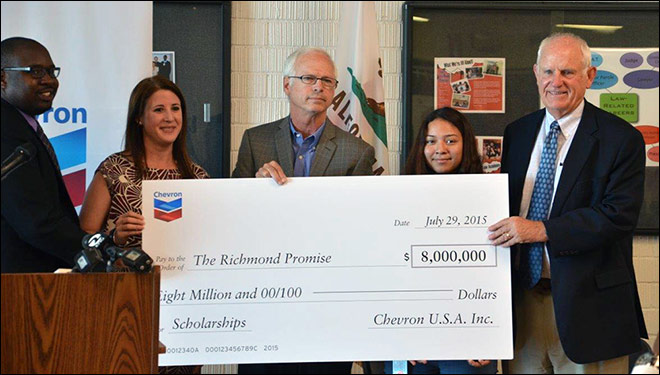
There is a broad range of Promise programs, but there are a small number of large comprehensive programs that supply millions of dollars in scholarships each year. The Richmond Promise in California is about to join them.

The Chevron Corporation — which has committed $35 million in agreement with a $1 billion modernization of its Richmond refinery — recently handed over its first check, a large one of $8 million to get the Promise started. The first recipients are expected to be the rising high school seniors of the Class of 2016.

Richmond City Manager Bill Lindsay — who was part of a six-person exploratory team at PromiseNet in November — told the Richmond Standard that college readiness was going to be an important component to the programming. He also said that the city hoped to leverage the Chevron commitment into $150 million in additional funds from foundations and private individuals.

Community leaders and school officials have yet to determine how funds will be distributed, but there is a call to make college both “attainable and affordable” for the most possible students. Vice Mayor Jael Myrick — who led the charge for the Richmond Promise as a city councilor — called the opportunity “transformative” and “game-changing.”

“This is real; this is happening,” Myrick said. “We expect young people after high school to still be in school.”

In Appreciation of Patience

patience-tenn

Adam Tamburin’s story in Saturday’s Tennessean had a simplistic headline — Success of Tennessee Promise hinges on student retention.

But patience will be far more important than retention in the early years of the statewide scholarship and mentoring program that was established just last year. While everyone wants immediate results to indicate huge progress, that’s not the way Promise programs go. Instead, early results are much more likely to be used as a hammer by critics.

There will be a lot of new types of students in both community colleges and colleges of applied technology thanks to the Tennessee Promise. Will their high school educations prove to be aligned to college expectations? Well, that’s one of the things a Promise program can identify. It is a long-term program that can make systemic change and alignment, but if its success hinges on immediate success, expect it to be seen as a failure.

State officials need to be addressing just that — achieving an end result doesn’t happen on a linear path. The more they learn about behaviors and adapt to what they discover, the more the Tennessee Promise will grow. Year one is pretty much about establishing a baseline. It’s more about learning than it is about expecting accomplishment. It’s about making sure pieces are in place to begin to analyze the results than to fret over the results themselves.

Yet this Tennessean story has already made assumptions, saying that data indicates the current approach by Tennessee community colleges has “not been successful” based upon 41 percent of first-year freshman not returning the following year. Yet there is no explanation of that number. Are students leaving because they have been underprepared by their high schools? Must they work long hours to simply survive and learn that the academic demands are too great to succeed at both?

We should be happy that the Tennessean is providing deep coverage of the Promise, but there is far too much to learn before making declarations about the success, or lack thereof, of the program. If folks want the Tennessee Promise to succeed, they’d do well not to submarine it by making judgments based on early indications.

Find patience, Tennesseans. Assess, discover, react, assess again. That can’t happen in a year.