By late summer there will be at least one new Promise program to be added to the Cities of Promise, but exactly where it will be is yet to be determined.
According to the Greensboro News-Record in North Carolina, the “leading contender” is its own Guilford County. That newspaper reported last week that Say Yes to Education — which has city-wide programs in Syracuse and Buffalo — is poised to become the organization’s first program outside the Northeast.
Wrote Marquita Brown of the News-Record:
Say Yes has considered applications from more than two dozen school systems and municipalities, Gene Chasin, the chief operating officer of Say Yes to Education, said through a spokesman.
The organization still is considering several of those school systems, Chasin said.
While evaluating communities, Say Yes is weighing such factors as the strength of local leadership, “the openness of local partners to working together, and the commitment of the local school district to its students graduating high school — and doing so college-ready,” Chasin said.
While Say Yes would provide about $15 million in support, local partners — in this case Guilford County Schools, the Guilford Education Alliance, the Community Foundation of Greater Greensboro and the High Point Community Foundation — would be responsible to raise funds to establish an endowment for college tuition scholarships.
“The Class of 2016 could be the first class to receive these opportunities,” said Maurice “Mo” Green, the superintendent of Guilford County Schools. To learn more about the positive measures coming out of Guilford Schools, please click here.
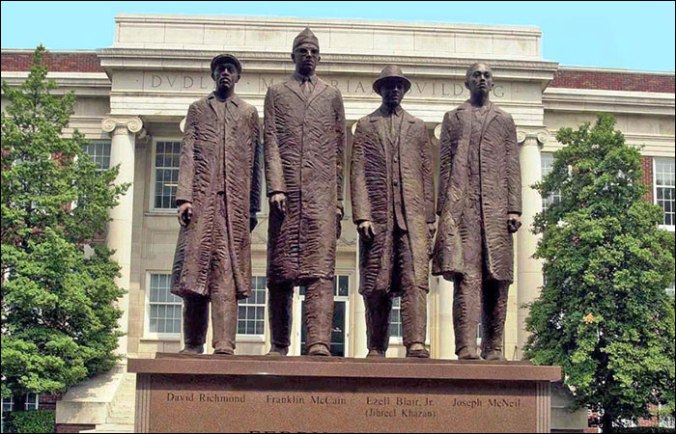
The photo above is a monument to the Greensboro Four, who generated attention to segregated conditions in the South with a 1960 lunch counter sit-in. The statue — which sits on the campus of North Carolina A&T State University in Greensboro — was dedicated in 2002.



 Education must also train one for quick, resolute and effective thinking. To think incisively and to think for one’s self is very difficult. We are prone to let our mental life become invaded by legions of half truths, prejudices, and propaganda. At this point, I often wonder whether or not education is fulfilling its purpose. A great majority of the so-called educated people do not think logically and scientifically. Even the press, the classroom, the platform, and the pulpit in many instances do not give us objective and unbiased truths. To save man from the morass of propaganda, in my opinion, is one of the chief aims of education. Education must enable one to sift and weigh evidence, to discern the true from the false, the real from the unreal, and the facts from the fiction.
  Cities Of Promise