The La Crosse Investment

lax-above

If tomorrow a rule came down that Promise programs could no longer use the word ‘Promise,’ what would be the replacement? In my mind, one word sums up the initiative: investment. The Pittsburgh Investment. Or the New Haven Investment.

The word comes up a lot. How many funders have heard, “It is critical that business invests in the community?” Or Promise Scholars working too many hours in a low-wage job, “You need to protect this investment!”

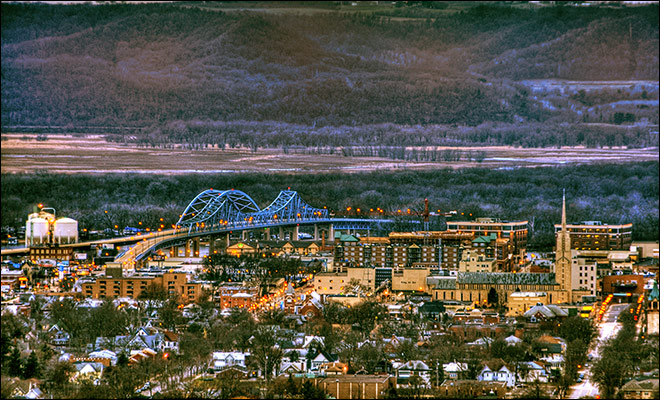
But up in La Crosse, Wis., the word has even deeper meaning. Recipients of the La Crosse Promise aren’t just required to live within city limits, they must invest in the city’s most challenged neighborhoods.

“We’re trying to attract market-rate homes … into [high-poverty] neighborhoods,” said Jerilyn Dinsmoor, executive director of the La Crosse Promise. “That way, we’re not leaving vacant homes and forgetting about a community … The health of the downtown affects the entire region. The more we can revitalize the core, the better for the entire region.”

Three anonymous donors have provided funds to offer $25,000 and $50,000 college scholarships to 30 families who move to two of La Crosse’s low-income neighborhoods adjacent to downtown.

Writes Malcolm Burnley of Next City:

In order to qualify, a family must agree to invest enough money into a home to raise the home value well above market rate (specifically, by putting $50,000 worth of renovations into a home assessed at under $150,000, or paying $150,000 in construction costs on a brand-new home).

In May, Justin Wolfers of the New York Times detailed two studies the demonstrated that “neighborhoods — their schools, community, neighbors, local amenities, economic opportunities and social norms — are a critical factor shaping your children’s outcomes.”

This is one investment worth watching.

A Neighborhood Turnaround

harris-rosen

Back in May, Lizette Alvarez of the New York Times focused on a man who grew up in a low-income neighborhood of the Lower Eastside in the 1950s.

Harris Rosen was the first person in his family to go to college, earning his 1961 degree from Cornell University’s renown School of Hotel Administration. Back to Gotham he went, serving as a convention salesman at the Waldorf Astoria.

Eventually he found himself in the convention capitol of the United States — Orlando, Fla. — where he’d turn a single highway hotel into an empire.

More than a decade ago, he donated the site for the University of Central Florida’s Rosen College of Hospitality Management. But that isn’t his most meaningful contribution to education. His impact on the community of Tangelo Park will be his greatest legacy.

In 1993 Rosen came to the troubled neighborhood for a school visit and asked a group of children how many wanted to go to college. “Two or three hands went up,” he remembered. He made a commitment to a change, inherently believing that the neighborhood’s best answer to crime and hopelessness was education.

In two decades, he has poured more than $10 million into the 3,000-resident Tangelo Park. In a community which once saw more than half of its young people drop out of school, there have been nearly 500 Rosen Scholars since. In the most informal way, his generous scholarships pay for tuition and fees, room and board, books and travel for those students who attend in-state public schools. There is no staff for the Tangelo Park Program. Volunteers — and Rosen himself — take care of the needs.

Residents credit Rosen’s investment with a thorough transformation of the neighborhood. “We are sitting on gold her now,” said Jeroline Adkinson, a resident and president of the Tangelo Park Civic Association. Where once so many would drop out of high school, now 20 of the 25 graduates from the Class of 2015 claimed their Rosen Scholarship.

In My Mind, I’m Going To Carolina

say-yes-guilford

We’ve been writing about this since January, but now we can officially say it — Welcome and congratulations, Guilford County!

Say Yes To Education — founded by George Weiss in 1987 in Philadelphia — made the official announcement today that Guilford County, which is home to both Greensboro and High Point, is its newest partner.

Led locally by the Guilford Education Alliance, the Community Foundation of Greater Greensboro, the High Point Community Foundation and Guilford County Schools, the region has already raised $32.5 million toward its $70 million goal to fund the endowment for last-dollar tuition scholarships. The district — which has a whopping 72,000 students — is comprised of largely low-income and minority students.

“They often have the smarts, they have the GPA, but the money is not there,” said Felicia Andrews, a parent and local Say Yes organizer.

The current class of seniors — more than 5,000 in total — will be eligible for the funds, although details regarding scholarship eligibility are still being finalized. More than 100 private colleges and universities are part of the Say Yes Higher Education Compact, which also serves students from Say Yes programs in both Buffalo and Syracuse.

Why Guilford County? “We had roughly 130 different cities and counties that we looked at, and we winnowed the list down to literally three, and Guilford County just blew everybody out of the ballpark,” Weiss told Katie Arcieri of the Triad Business Journal. “What made the county stand out? Every time we had a board meeting, Guilford County was just shining like a star. There was really no discussion. What we need is people to put aside their differences and just help the kids, and that’s what Guilford County did.”

So it was easy to say yes.

A Stadium, A Promise Or Both?

atlanta-stadium

Last month in Atlanta, it was announced that Mercedes Benz had purchased the naming rights to the new football stadium which will replace the 23-year-old Georgia Dome in 2017.

Perhaps the most intriguing thing about the naming agreement was its length of term. It will expire in 2042. If recent history is a guide, that will be about the time that the stadium — despite this cool fly-through — will be imploded. Washington Redskins’ owner Daniel Snyder is, in fact, talking about a new stadium even though FedEx Field just turned 18.

Maybe I shouldn’t pick on Atlanta, because as Richard Florida notes, it could just as well be Dallas or Minneapolis or Buffalo or Cleveland or the Bay Area.

But there is something special about taxpayers footing $600 million in the construction of this new stadium for the mighty Atlanta Falcons, a team that has won 44 percent of its games all-time and has such a notable “Ring of Honor” with the likes of Steve Bartkowski, William Andrews, Gerald Riggs, Jeff Van Note, Jessie Tuggle, Tommy Nobis, Mike Kenn, Claude Humphrey and Deion Sanders. Let’s call them “Neon and the Eight Who’s?”

Yes, $600 million… for a stadium that will likely last 25 years. What is a building’s legacy once it is demolished? Memories?

Is it possible to use this opportunity to float an idea that would truly leave a lasting legacy?

The person getting the most from the taxpayers’ $600 million is Falcons’ owner Arthur Blank, the Home Depot co-founder who is worth about $3 billion. He has also founded the Atlanta United FC soccer team, which will use the Mercedes-Benz Stadium until its inevitable demise.

The 72-year-old Blank signed the “Giving Pledge” in 2012, thus committing to give away at least half of his fortune someday.

Here’s a start. If he developed a city-wide Atlanta Promise program, beginning in 2017, which — in combination with federal financial aid — made college affordable at in-state institutions for every city high school graduate with a 2.5 grade-point average, it would take more than 25 years to spend $500 million (which is less than 20 percent of Blank’s assets).

It’s pretty simple — changing an academic culture by incentivizing and investing in its people would provide a double benefit for the city and the Falcons. After all, a Promise program could substantially increase the number of residents who could afford a visit to the stadium.