Heads Up America: The Focus On Affordability Just Got Real

It’s an audacious plan — to basically change K-12 public education to K-14 — but President Barack Obama doubled down on his Heads Up America proposal of free community college last week. He first broached the American College Promise in January in his State of the Union address, but it was clear that the odds of a successful Congressional act to address a new $60 billion educational investment would be long. A Hail Mary pass plus a two-point conversion long.

But at Macomb Community College in Warren, Mich., on Wednesday he called education “the secret sauce to America’s success,” referred to “a Movement going on,” and unveiled an advisory board of educators, business and non-profits leaders and politicians who will study different models and spread the word about free tuition. The advisory board — chaired by Dr. Jill Biden — is available here.

“I’ve been focused on community colleges,” Obama said in his speech. “They are at the heart of the American dream. For every young person willing to work hard, I want community college to be as free and universal as high school. It’s easy for politicians to say young people are the future. But you’ve got to walk the walk. No kid should be priced out of a college education. No hardworking young person should be denied just because of where they started. You don’t have to necessarily go to a four-year degree to get a good job, but you need to have some specialized skills.”

This initiative has recently been formalized in Tennessee and Oregon and is being piloted in Minnesota. It has also been established by community college systems in places like Miami, Chicago, Seattle and Philadelphia.

Threading the needle with an act of Congress is not required. Colleges, cities and states have already created incentives and motivations for students that are “willing to work for it” and there is significant federal money already out there. What’s needed is awareness, courage, will and additional funds to close the gaps.

President Obama and Department of Education Secretary Arne Duncan will be speaking about college access and affordability on Monday at North High School in Des Moines, Iowa, as part of Duncan’s annual back-to-school bus tour. Without question, one of the topics will be the Department of Education’s new College Scoreboard, which is a massive collection of data regarding success, debt and income of those receiving financial aid or loans from the federal government. Click here for a fascinating piece on how the data was collected and prepared for public consumption.


Protecting The Promises

star-chicago

At its best, the Promise movement attacks the opportunity gap. But to sustain a Promise program is hardly an easy task. By design, such a program motivates students to perform well academically thus a growing number are expected to meet the requirements each year. On top of that, there is no indication that increasing college costs will level off.

So Promise programs — perhaps the best intervention in attacking the opportunity gap — struggle to keep up. Most of the recent Promise news is focused on finance. Here’s a spin around the nation:

star-denverVoters in Denver, Colo., might be asked to take on responsibility of funding the Denver Scholarship Foundation. The proposal before the Denver City Council is a sales tax increase of 0.08 percent — less than a penny for a $10 purchase — which would generate about $10 million for the scholarship organization. One councilman reported that his constituency is asking why this has become a city responsibility, but a recent study uncovered a nine-fold return on money spent by the Denver Scholarship Foundation. That in a state that has been ranked 47th in the U.S. for higher education funding.

Known locally as UIC, the University of Illinois-Chicago recently stepped up to sweeten the pot for recipients of the Chicago Star Scholarship, which gives free community college tuition to high-performing city students. UIC has offered guaranteed admission and up to $5,000 in support for those who earn an associate’s degree through the program. And outspoken Mayor Rahm Emanuel promised to be knocking on the doors of others to talk about their “responsibility to the kids of Chicago.” Emanuel made it clear that he wants higher ed support and he wants it soon, saying, “It would be easy to step back, observe the problem, study the problem, have a couple papers written on the problem, have a symposium on the problem, discuss what people should do about the problem and then go for a break and have a cup of coffee.”

Down in Greensboro, N.C., where more than $25 million has been raised toward an endowment for a Say Yes To Education program, city officials were hardly unanimous in their support of the initiative. At issue? The leaders of the campaign did not reach out to the Guilford County Board of Commissioners until “the ninth inning,” according to the board chair. That county board is also displeased that the early discussion did not include the county’s charter school students, which is “significantly different than where [the Say Yes to Education] board thought we were headed,” according to Gene Chasin of Say Yes.

Two faculty members of the University of Pittsburgh penned an op-ed piece in the Post-Gazette that asked for a focus on state funding for higher education, instead of hand-wringing about recent changes to the Pittsburgh Promise. Lindsay Page and Jennifer Iriti wrote that the purchasing power of the Promise will decline in the face of a lack of support of higher education in the state. “As a community, we should celebrate and grow the gift of The Promise, but we also should seek to protect that gift by pushing Harrisburg to reinvest in public higher education,” the piece concluded. “Without such reinvestment, continued increases in the costs of higher education faced by families will do more to hinder access to the promise and opportunity of higher education than the recent scaling back of The Pittsburgh Promise.”

Investigate The Promise Investment

PromiseNet is heading back to Kalamazoo, Mich., and registration for the event — which will take place Nov. 10-12, 2015 — is now open.

pnwt-2015The early registration rate is $275 (though there is $50 per person reduction for those with groups of at least three). Those rates go up $25 per person starting Oct. 12. There is also a single-day rate of $175 for Nov. 11, which includes all-day programming followed by the Kalamazoo Promise 10th Anniversary Gala.
The kickoff event for Promise programs will be a luncheon featuring remarks from Wes Moore, a Rhodes Scholar and decorated Army combat veteran who has launched BridgeEdU. That initiative — which focuses on college completion and career placement — looks to reinvent the freshman year of college by providing a “softer on-ramp” to higher education. Moore has been well covered, including features on Meet the Press, The Daily Show with Jon Stewart, The View, MSNBC, NPR, USA Today and People Magazine. He also also hosts Beyond Belief on the Oprah Winfrey Network and serves as the executive producer and host of Coming Back with Wes Moore on PBS.

The breakout sessions will cover considerable ground, including research findings on the impact of selected Promise programs, discussion on how to begin with fundraising and managing a Promise program and a focus on students beyond enrollment and graduation from college. Click here for the full agenda.

This will be the seventh PromiseNet conference. Last year’s event in New Haven, Conn. — the first one held on the East Coast — attracted more than 100 organizations, including a dozen from California. The video above was produced by New Haven Promise and you can click here for a series of images from PromiseNet 2014.

A Personal Promise

ud-mia

By Brett Hoover

Reading this story of Promise, which posted in the Dayton Daily News Monday, was a bit personal.

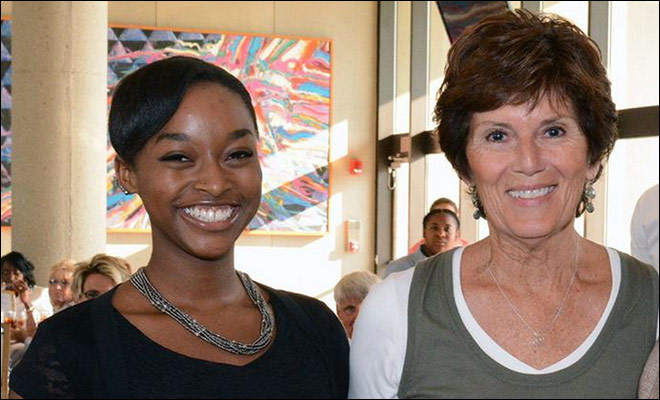
Not only is this Promise Scholar — Mia DeBrill (above with her mentor Pam Smiga) — now enrolled at the University of Dayton, making her my fellow Flyer, but it reminded me of my youth.

That’s because my father served the University of Dayton for a quarter century, most of it overseeing admissions, financial aid and scholarships. His approach was unlike anything that had been seen. He’d come to the University as a successful football coach, but had to look for greater stability once he had an unexpected third child (me).

A series of hard-fought recruiting victories made administrators take notice and wonder if he might be the person to attack a sagging enrollment. In his switch from athletics to admissions he kept his football approach. Competing wasn’t enough. “To Jim,” said the school’s chief financial officer, “the idea was to go out and win.”

The disruption turned UD’s fortunes. In an era where many private schools suffered declining enrollment, Dayton experienced double-digit increases.

And with all the things he oversaw, perhaps the thing that drew his deepest interest were the scholarship opportunities for students from the City of Dayton. Like many cities, Dayton was built with segregation in mind. The westside of Dayton — separated from downtown by the Great Miami River — was designed to isolate the area’s low-income black residents.

The University of Dayton — one of three Marianist colleges in the United States — sits on the other side of town, a neighborhood of working-class whites on one side and old-money blue blood families on the other.

While I failed to realize, when I was younger, that the school was not a welcoming place for many minorities, I am happy to report that my alma mater has worked to address that into the 21st century. An innovative partner program — the Dayton Early College Academy — has been established across the street.

It also brings me joy to know that UD partners with the Montgomery County Ohio College Promise, which is funding Mia DeBrill’s education. Being there for her — and others to come — might just be more meaningful than providing funds.

External resources and initiatives have changed outcomes since the 1970s and 1980s, when my father was among the few who knew the challenges of black students and the shortcomings of the university. My father recognized that lack of diversity on campus — in a city with more than 40 percent black residents — was both a sore spot for both the city and the university and a drawback for all the students.

He didn’t want to lose any black students. He took all the knowledge and resources he had to make things work for them. Sometimes it wasn’t enough, but I would also hear from my fellow classmates about the difference he made. My dad never stopped being a football coach at heart. There was nothing fluffy about him. Yet I’d hear stories from folks who had stories about his warmth. I eventually had to stop questioning them about it.

James Hoover passed away 12 years ago. Not long after that I quit my job to follow the passion he instilled in me. Most days, at some point, I talk with a first-generation-to-college student or a parent, helping them navigate the difficult process of getting to and through college. I suspect finding joy in that must be in my DNA.

And I want to wish Mia, my fellow Flyer, all the luck in the world!


Brett Hoover — who formerly served as the Associate Director of the Ivy League — is a co-founder of Cities of Promise.